Explore our posters presented at international conferences and meetings. Click on any poster image to view the full poster.
2026
66th Annual Meeting of the Japanese Society for Inherited Metabolic Diseases (JSIMD) , Fukuoka, Japan
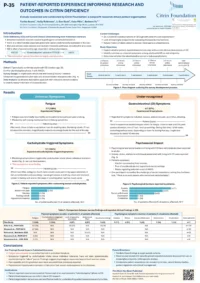
Title: Patient-Reported Experience Informing Research and Outcomes in Citrin Deficiency
This poster presents findings from an in-depth survey of seven adults with citrin deficiency, highlighting universal fatigue and carbohydrate-triggered symptoms, alongside under-recognised gastrointestinal and psychological burdens. The findings challenge the traditional understanding of the “silent/adaptive” phase as asymptomatic and emphasise the importance of incorporating patient experiences into future research and the development of patient-reported outcome measures.
Society For the Study of Inborn Errors of Metabolism (SSIEM) Annual Symposium , Helsinki, Finland
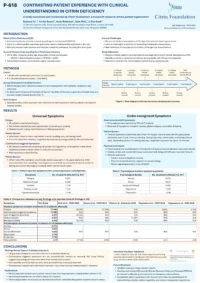
Title: Contrasting Patient Experience with Clinical Understanding in Citrin Deficiency
This poster examines how the lived experiences of adults with citrin deficiency compare with what is currently described in the clinical literature. It highlights that fatigue, carbohydrate-triggered symptoms, gastrointestinal issues, and psychological burdens may be more common or more under-recognised than previously understood, showing the importance of patient-reported experiences in shaping future research and care.
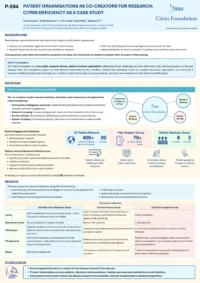
Title: Patient Organisations as Co-Creators for Research: Citrin Deficiency as a Case Study
This poster shows how Citrin Foundation acts not only as a patient advocacy group but also as a research-enabling partner that connects patients, clinicians, and researchers. It demonstrates how this co-creation model helps overcome barriers in rare disease research by supporting recruitment, engagement, and study delivery, making research more feasible and patient-centred.
Abstract
Background
Citrin deficiency (CD) is a pan-ethnic, complex inherited liver metabolic disease and urea cycle disorder caused by mutations in the
SLC25A13 gene, encoding the mitochondrial aspartate glutamate carrier (AGC2) protein. It affects multiple metabolic pathways,
including the malate-aspartate shuttle, glycolysis, gluconeogenesis, de novo lipogenesis, beta-oxidation, the TCA and urea cycles.
Due to its unique role in metabolism, its heterogeneous phenotypes and diverse symptoms, it poses significant diagnostic and
therapeutic challenges. Citrin Foundation therefore aims to elucidate the pathogenesis of CD using a holistic and multidisciplinary
approach, with the ultimate goal of finding a cure.
Case Study/Methods
Significant funding and resources have been committed to these goals. A comprehensive assessment of the CD landscape was
undertaken, leading to the implementation of a holistic strategy ranging from basic science research to translational research to
clinical initiatives and studies. A multidisciplinary consortium of clinicians, scientists and biotech companies was established and
linked to work together collaboratively. Rigorous grant review processes ensured that targeted projects were funded. Patients
were mobilized and supported.
Results
The effects of mutations on citrin protein function, bioenergetics, and biogenesis were investigated. New preclinical models were
developed to better recapitulate human CD. Flux studies were used to analyse the metabolic consequences of CD. Large patient
cohorts were assembled for studies such as a multi-omics study to identify biomarkers. Improved newborn screening methods were
devised. Ureagenesis tests were performed in patients. Strategic centres were established. Various therapeutic options, from small
molecules to gene editing, are being evaluated.
Discussion/Conclusion
Despite our early success, advancing technologies can further our goals. We invite others to use innovative methods to unravel this
metabolic enigma, which will have scientific implications beyond CD.
.
2025
Urea cycle Disorders Satellite Symposium, Kyoto, Japan
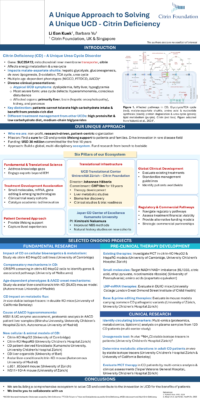
Title: A Unique Approach to Solving a Unique UCD – Citrin Deficiency
This poster highlights Citrin Foundation’s unique, multidisciplinary approach to advancing research and treatment development for citrin deficiency. It showcases the Foundation’s global research ecosystem and ongoing initiatives spanning fundamental research, preclinical therapy development, and clinical studies, with the ultimate goal of improving patient care and finding a cure.
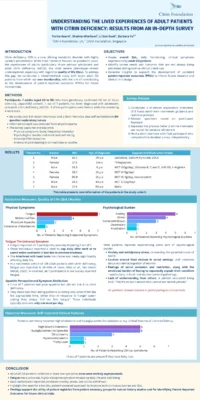
Title: Understanding the Lived Experiences of Adult Patients with Citrin Deficiency: Results from an In-Depth Survey
This poster presents findings from an in-depth survey of seven adults living with citrin deficiency, exploring their symptoms, daily functioning, and quality of life. The results highlight fatigue as a universal and highly disruptive symptom, alongside psychological burdens and other clinical challenges, emphasising the need for patient-centred research and the development of patient-reported outcomes for future clinical trials.
Citrin Foundation 3rd In-Person Global Symposium, Cambridge, United Kingdom
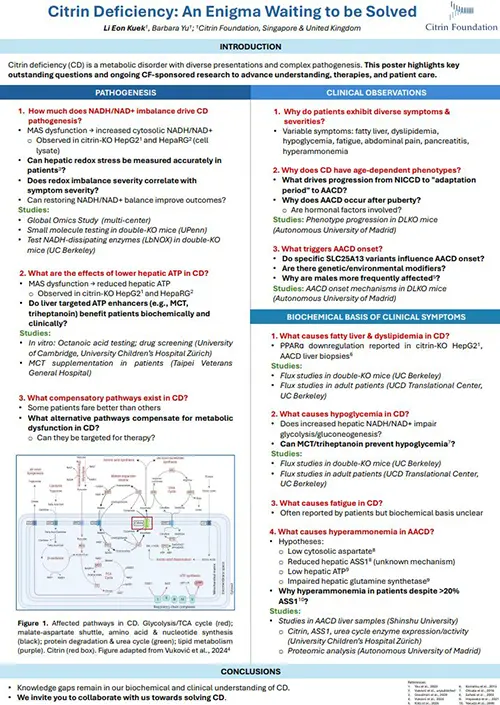
Title: Citrin Deficiency: An Enigma Waiting to be Solved
The poster highlights key unanswered questions surrounding the underlying mechanisms of citrin deficiency, including its diverse clinical manifestations, age-related progression, and metabolic disturbances. It explores current hypotheses and ongoing research, aiming to stimulate scientific discussion and identify new avenues for understanding the condition.
Abstract
Background
Citrin deficiency (CD) is a pan-ethnic, complex inherited liver metabolic disease and urea cycle disorder caused by mutations in the
SLC25A13 gene, encoding the mitochondrial aspartate glutamate carrier (AGC2) protein. It affects multiple metabolic pathways,
including the malate-aspartate shuttle, glycolysis, gluconeogenesis, de novo lipogenesis, beta-oxidation, the TCA and urea cycles.
Due to its unique role in metabolism, its heterogeneous phenotypes and diverse symptoms, it poses significant diagnostic and
therapeutic challenges. Citrin Foundation therefore aims to elucidate the pathogenesis of CD using a holistic and multidisciplinary
approach, with the ultimate goal of finding a cure.
Case Study/Methods
Significant funding and resources have been committed to these goals. A comprehensive assessment of the CD landscape was
undertaken, leading to the implementation of a holistic strategy ranging from basic science research to translational research to
clinical initiatives and studies. A multidisciplinary consortium of clinicians, scientists and biotech companies was established and
linked to work together collaboratively. Rigorous grant review processes ensured that targeted projects were funded. Patients
were mobilized and supported.
Results
The effects of mutations on citrin protein function, bioenergetics, and biogenesis were investigated. New preclinical models were
developed to better recapitulate human CD. Flux studies were used to analyse the metabolic consequences of CD. Large patient
cohorts were assembled for studies such as a multi-omics study to identify biomarkers. Improved newborn screening methods were
devised. Ureagenesis tests were performed in patients. Strategic centres were established. Various therapeutic options, from small
molecules to gene editing, are being evaluated.
Discussion/Conclusion
Despite our early success, advancing technologies can further our goals. We invite others to use innovative methods to unravel this
metabolic enigma, which will have scientific implications beyond CD.
.
2024
Society for the Study of Inborn Errors of Metabolism (SSIEM) Annual Symposium, Porto, Portugal
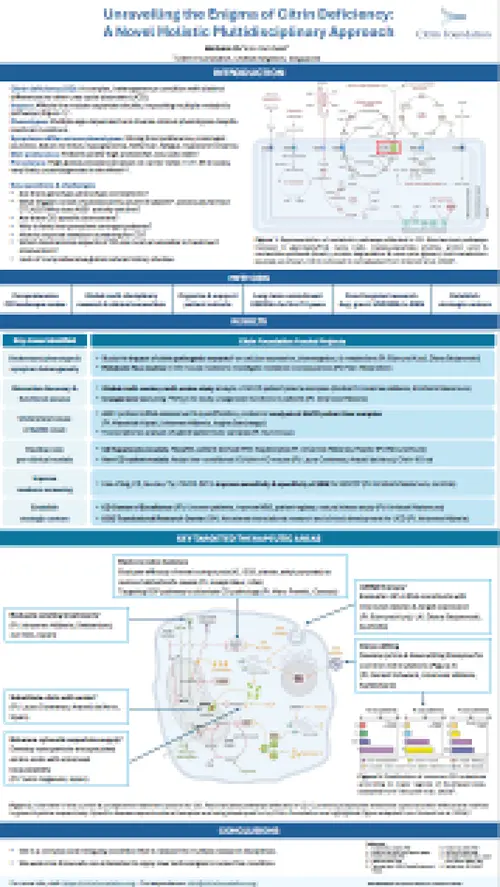
Title: Unravelling the Enigma of Citrin Deficiency: A Novel Holistic Multidisciplinary Approach
The poster emphasized the complexity of citrin deficiency, highlighted key research questions, and detailed the Foundation’s comprehensive strategy for addressing these challenges to advance the development of effective treatments. It also encouraged collaboration, inviting those with an interest in progressing research and therapeutic approaches for citrin deficiency to join the Foundation’s efforts.
Abstract
Background
Citrin deficiency (CD) is a pan-ethnic, complex inherited liver metabolic disease and urea cycle disorder caused by mutations in the
SLC25A13 gene, encoding the mitochondrial aspartate glutamate carrier (AGC2) protein. It affects multiple metabolic pathways,
including the malate-aspartate shuttle, glycolysis, gluconeogenesis, de novo lipogenesis, beta-oxidation, the TCA and urea cycles.
Due to its unique role in metabolism, its heterogeneous phenotypes and diverse symptoms, it poses significant diagnostic and
therapeutic challenges. Citrin Foundation therefore aims to elucidate the pathogenesis of CD using a holistic and multidisciplinary
approach, with the ultimate goal of finding a cure.
Case Study/Methods
Significant funding and resources have been committed to these goals. A comprehensive assessment of the CD landscape was
undertaken, leading to the implementation of a holistic strategy ranging from basic science research to translational research to
clinical initiatives and studies. A multidisciplinary consortium of clinicians, scientists and biotech companies was established and
linked to work together collaboratively. Rigorous grant review processes ensured that targeted projects were funded. Patients
were mobilized and supported.
Results
The effects of mutations on citrin protein function, bioenergetics, and biogenesis were investigated. New preclinical models were
developed to better recapitulate human CD. Flux studies were used to analyse the metabolic consequences of CD. Large patient
cohorts were assembled for studies such as a multi-omics study to identify biomarkers. Improved newborn screening methods were
devised. Ureagenesis tests were performed in patients. Strategic centres were established. Various therapeutic options, from small
molecules to gene editing, are being evaluated.
Discussion/Conclusion
Despite our early success, advancing technologies can further our goals. We invite others to use innovative methods to unravel this
metabolic enigma, which will have scientific implications beyond CD.
.
45th Society for Inherited Metabolic Disorders (SIMD) Annual Meeting, Charlotte, North Carolina, United States
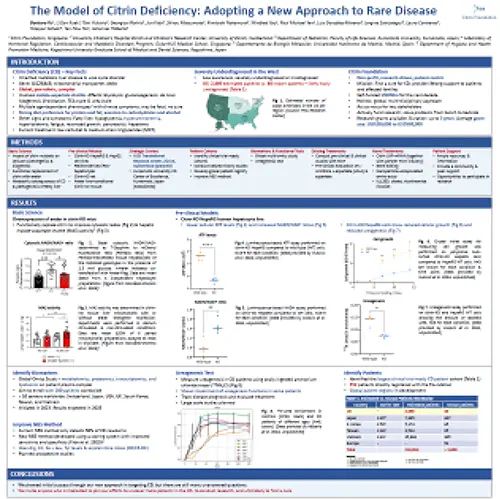
Title: The Model of Citrin Deficiency: Adopting a New Approach to Rare Disease
The poster delved into the scientific and clinical background of citrin deficiency, outlining the multidisciplinary and diverse methodologies adopted to address this complex condition. It further highlighted the need to improve diagnosis and awareness in North America and provided an in-depth overview of the Foundation’s novel approach towards solving citrin deficiency. The findings of several Foundation-sponsored studies were also showcased.
Abstract
Background
Citrin deficiency (CD) is a rare metabolic condition due to mutations in the SLC25A13 gene encoding citrin. Citrin is the mitochondrial aspartate-glutamate carrier, a component of the malate-aspartate shuttle, involved in moving reducing equivalents (NADH) from the cytosol into the mitochondria and for supplying aspartate to the cytosol. CD is a complex disorder with diverse phenotypes. It primarily affects the liver with several major pathways including glycolysis, gluconeogenesis, lipid metabolism, the TCA cycle and ureagenesis being impacted.
Based on published carrier rates in several East Asian ethnicities and considering their respective populations, the expected number of CD patients in the United States would be approximately 2,000. However, there are currently <50 CD patients in the US known to the scientific community.
To close this dramatic gap in diagnosis, Citrin Foundation, a non-profit, research-driven, patient-centric organization dedicated to finding a cure for CD, proposes a new long-term, holistic, innovative, global and multidisciplinary approach to tackle rare diseases, using CD as a model disease.
Methods
Acting as a nexus, Citrin Foundation brings together key stakeholders (researchers, clinicians, patients, biotech) to solve problems from bench to bedside, and has committed substantive resources for its cause over the next decade (www.https://citrinfoundation.org/).
For basic science, we are studying the intracellular localization, transport activity, and biogenesis consequences of pathogenic SLC25A13 variants and developing new preclinical models. For clinical strategy, we seek to identify more patients in preparation of cohort studies and patient registries. Before interventional studies for CD can begin, a reliable biomarker and functional assays to monitor disease progression must be established. A range of treatments are being investigated, from small molecules that may ameliorate the impact of the disease to gene therapies. Patients and families are provided with information, support and encouragement to participate in clinical studies. Below, some initial results are listed.
Results
In basic science, Citrin-knockout HepG2 cells were shown to have lower ATP production, increased NADH/NAD+ ratios, and reduced mitochondrial maximum respiratory capacity, indicating their potential as a CD model. Another preclinical study showed that aralar, a protein highly homologous to citrin, with identical function, can functionally replace citrin in the mouse liver. For improving diagnosis to identify more patients, a new scoring system for CD using the present NBS system was devised with improved specificity and sensitivity. For biomarker detection, we are currently conducting a multi-omics study in >300 patients, some of whom will also be studied for their ureagenesis function using stable isotopes flux methods. In initial treatment investigations, nicotinamide riboside was shown to rescue dysregulated glycolysis and fatty acid β-oxidation in Citrin-knockout HepG2 cells. L-ornithine L-aspartate was shown to reduce hyperammonemia in a Citrin/mGPD double-knockout mouse model.
Conclusions
CD is severely underdiagnosed in many parts of the Western world. The approach proposed by Citrin Foundation foresees overcoming many of the universal challenges in tackling rare diseases by fostering a global consortium of scientists, clinicians, and biotech companies working together with patients collaboratively. The success of this approach is demonstrated by its first achievements that hopefully encourage others to join our consortium.
.
2023
Citrin Foundation 2nd In-Person Global Symposium, Cambridge, United Kingdom
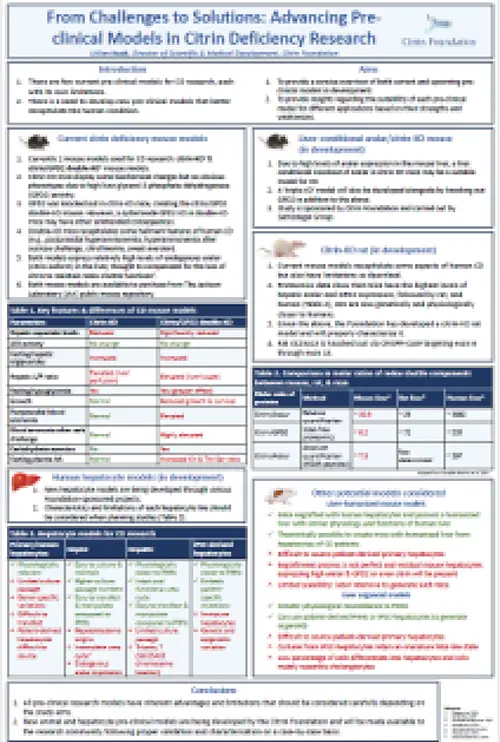
Title: From Challenges to Solutions: Advancing Pre-clinical Models in Citrin Deficiency Research
The poster provided an overview of the current pre-clinical research models for citrin deficiency, highlighting their limitations and the need for better models that more accurately mimic the human condition. It also presented an overview of ongoing Foundation-sponsored studies developing new cellular and animal models for citrin deficiency, offering detailed insights into the suitability of each model for various research purposes.
Citrin Foundation 2nd In-Person Global Symposium, Cambridge, United Kingdom
At the 2nd In-Person Global Citrin Deficiency Symposium hosted by Citrin Foundation at Magdalene College, University of Cambridge, the Foundation showcased a poster titled “From Challenges to Solutions: Advancing Pre-clinical Models in Citrin Deficiency Research”.
The poster provided an overview of the current pre-clinical research models for citrin deficiency, highlighting their limitations and the need for better models that more accurately mimic the human condition. It also presented an overview of ongoing Foundation-sponsored studies developing new cellular and animal models for citrin deficiency, offering detailed insights into the suitability of each for various research purposes.
Abstract
Preclinical models play a crucial role in enhancing our understanding of citrin deficiency (CD) and assessing potential therapies. However, the available preclinical models for CD research are currently limited. Most studies have relied on the citrin-KO and citrin/mGPD double-KO mouse models, along with initial attempts to establish a human hepatocyte cell line model. While these models have provided valuable insights, they also have inherent limitations. To address this issue, the Citrin Foundation has comprehensively evaluated the preclinical research landscape and actively pursuing the development of novel cellular and animal models to facilitate CD research. Ongoing Foundation-sponsored projects involve creating citrin knock-out and/or citrin mutant knock-in models of human hepatocyte lines (e.g., HepaRG, HepG2) and citrin-KO animal models (e.g., liver-conditional aralar-KO mouse model, citrin-KO rat model). This presentation aims to provide a detailed evaluation of current and upcoming preclinical models for CD research, discussing their respective advantages and limitations.