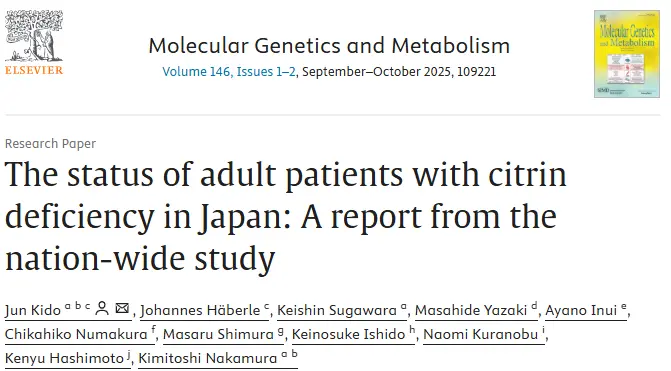
We are pleased to announce the publication of a new research paper on citrin deficiency (CD) in Molecular Genetics and Metabolism titled “The status of adult patients with citrin deficiency in Japan: A report from the nation-wide study” available for viewing here: https://doi.org/10.1016/j.ymgme.2025.109221. It was first-authored by Jun Kido, with Kimitoshi Nakamura (Kumamoto University) as senior author, and included contributions from Johannes Häberle (University Children’s Hospital Zürich), their longstanding collaborator. This work was partially supported by Citrin Foundation.
Long-term outcomes in adult patients with citrin deficiency have remained poorly understood and often underrepresented in cohort studies, particularly in patients with adolescent and adult citrin deficiency (AACD). To address this gap, the present study analyzed clinical data from 128 Japanese adult citrin deficiency patients, the largest cohort and first study of its kind, providing important insights into the clinical course of citrin deficiency in adulthood.
Patients were grouped by disease onset into neonatal intrahepatic cholestasis caused by CD (NICCD), post-NICCD, and AACD. Adults with a history of NICCD generally showed favorable long-term outcomes, while those diagnosed later with AACD were more likely to develop persistent or worsening symptoms, including hepatic encephalopathy, intellectual disability, and reduced quality of life. The hepatic condition observed in AACD was hypothesized to resemble end-stage metabolic dysfunction-associated steatotic liver disease (MASLD), suggesting that patients may experience irreversible liver damage. These findings underscore the importance of early diagnosis and sustained intervention to improve long-term prognosis.
We warmly congratulate all authors on their contributions to this impactful publication.
The Foundation continues to fund research projects to better understand citrin deficiency and ultimately find a cure for this condition. We have thus far earmarked US$30 million for research on citrin deficiency and are offering generous research grants to study the condition. You may find out more about our Funding Opportunities here: https://citrinfoundation.org/research/funding-opportunities
We value any feedback or ideas you might have, so please do not hesitate to contact us at info@citrinfoundation.org