We are pleased to share that a new study on citrin deficiency has been published in the journal Molecular Genetics and Metabolism, titled “Development of a quantitative real-time PCR-based newborn screening system for citrin deficiency using dried blood spots” . This work was first authored by Jun Kido, with Kimitoshi Nakamura (Kumamoto University) as senior author, and included contributions from long standing collaborator Johannes Häberle (University Children’s Hospital Zürich). The Citrin Foundation partly supported this work and warmly congratulates all authors on this important publication.
You may read the full publication here: https://doi.org/10.1016/j.ymgme.2026.109912
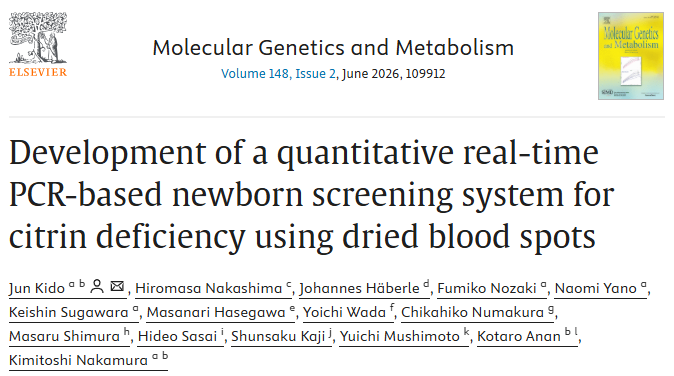
This study addresses the challenge of limited sensitivity in current Japanese newborn screening for citrin deficiency. The authors developed a quantitative real-time PCR-based screening approach using dried blood spots to detect the six most common pathogenic SLC25A13 variants in Japan., This approach could represent a rapid cost effective way to improve newborn screening sensitivity that is compatible with existing workflows, supporting earlier diagnosis and intervention to improve long-term outcomes in citrin deficiency patients.
Key findings showed that combining metabolite-based scoring with the qPCR assay may substantially improve screening sensitivity for citrin deficiency. The assay reliably distinguished wild type, heterozygous, and homozygous genotypes, while remaining rapid, cost effective, and compatible with existing newborn screening workflows.
These findings may support earlier diagnosis and intervention, which are important for improving long-term outcomes in citrin deficiency patients.